Quick Answer
Should you rent or buy a home in Tampa Bay in 2026?
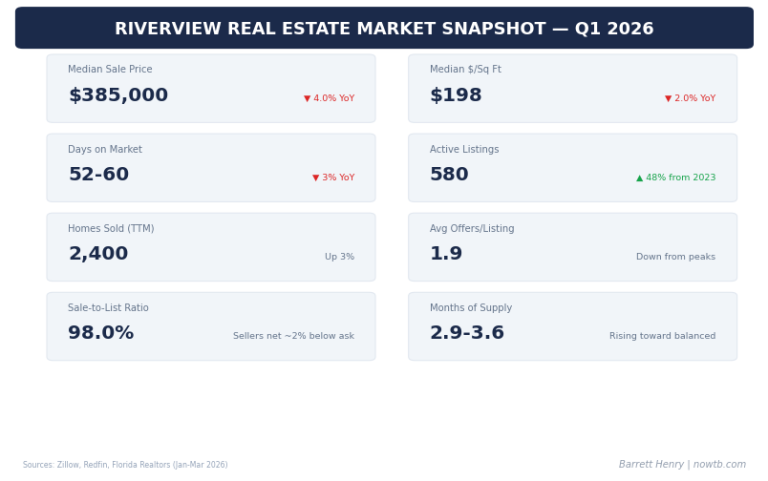
With Tampa Bay rents at 4-year lows and mortgage rates stabilizing, buying now can be $200-$400/month cheaper than renting in many areas – plus you build equity and get the homestead exemption tax savings. The math increasingly favors buying. Read our rent vs buy analysis, understand homestead savings, and explore Tampa Bay homes for sale.
Should you rent or buy in Tampa Bay? It’s the most common question I hear from people moving to the area, and the honest answer is: it depends. The internet is full of “buying is always better” propaganda, and I say that as someone who makes a living helping people buy homes. I’m Barrett Henry with REMAX Collective, and I’ve worked with hundreds of buyers across Brandon, Riverview, Tampa, and St. Pete. Some of them I’ve told straight up: you should keep renting right now. That’s because the rent-vs-buy decision isn’t about ideology – it’s about math, timing, and your personal situation. This guide breaks down the real numbers so you can make the right call for your life, not someone else’s.
If you’re already leaning toward buying, my first-time home buyer guide for Brandon FL covers everything from loan programs to closing costs. But if you’re not sure yet, keep reading – I’ll give you the honest comparison.
The Numbers – Renting vs. Buying Side by Side
Let’s start with the math. Here’s what it actually costs to rent a 3-bedroom home versus buying an equivalent home in the Tampa Bay area. These numbers reflect current market conditions – median rents and a purchase price of $360,000 (the approximate median for a 3BR/2BA single-family home in suburban Tampa Bay) with 5% down at a 6.75% interest rate on a 30-year fixed mortgage.
| Monthly Expense | Renting (3BR Home) | Buying ($360K Home) |
|---|---|---|
| Base Payment | $2,100-$2,400 (rent) | $2,215 (principal & interest) |
| Property Taxes | $0 (included in rent) | $375-$435 (with Homestead Exemption) |
| Homeowners / Renters Insurance | $25-$40 (renters) | $220-$350 (homeowners) |
| PMI (Private Mortgage Insurance) | $0 | $170-$210 |
| HOA Fees | $0 (typically included) | $0-$150 |
| CDD Fees (if applicable) | $0 | $0-$250 |
| Maintenance & Repairs | $0 (landlord’s responsibility) | $250-$400 (budget 1% of home value/year) |
| Lawn Care / Pest Control | $0 (often included) | $80-$150 |
| Total Monthly Cost | $2,125-$2,440 | $3,310-$4,160 |
| Equity Built (Monthly) | $0 | ~$400-$450 |
| True Net Cost (After Equity) | $2,125-$2,440 | $2,910-$3,710 |
At first glance, buying looks more expensive. And in the short term, it is. But that table doesn’t capture the full picture – equity accumulation, tax benefits, the Homestead Exemption’s cap on assessment increases, and the fact that your mortgage payment stays fixed while rent keeps climbing. We’ll get into all of that below.
When Buying Makes Sense
Buying a home in Tampa Bay is the right move for a lot of people – but for the right reasons, not just because someone told you “renting is throwing money away.” Here’s when buying genuinely wins.
You’re Building Equity Every Month
Every mortgage payment splits between principal (your equity) and interest (the bank’s cut). On a $342,000 loan (5% down on $360K), roughly $400-$450/month goes toward principal in the first year – and that amount increases every month as the loan amortizes. After 5 years, you’ll have built approximately $30,000-$35,000 in equity from payments alone, not counting any home price appreciation. Renters build exactly $0.
Florida’s Homestead Exemption Saves You Thousands
Florida’s Homestead Exemption is one of the most powerful homeowner protections in the country. It exempts up to $50,000 of your home’s assessed value from property taxes, saving you $800-$1,200 per year on a typical Tampa Bay home. But the bigger benefit is the Save Our Homes cap – once you homestead, your assessed value can only increase by a maximum of 3% per year, regardless of how much the market value rises. In a market where home values have been climbing 5-10% annually, that gap between assessed value and market value grows significantly over time.
Your Mortgage Payment Is Locked In
With a 30-year fixed mortgage, your principal and interest payment never changes. It’s the same in year 1 as it is in year 15. Meanwhile, Tampa Bay rents have increased an average of 5-10% per year over the past several years. That $2,200/month rental today could easily be $2,650 in three years and $3,200 in five. Homeowners are insulated from that escalation – your biggest housing cost is locked in the day you close.
Freedom to Customize and Control
When you own, you can paint, renovate, landscape, add a pool, or convert a garage into a home office without asking anyone’s permission. You decide on pets, roommates, and how long you stay. That autonomy has real quality-of-life value that doesn’t show up on a spreadsheet.
Long-Term Wealth Building
Real estate has historically been the primary wealth-building vehicle for American families. In Tampa Bay specifically, home values have appreciated substantially over the past decade. Combine mortgage paydown with appreciation and you’re looking at a significant asset after 7-10 years of ownership. For many of my first-time buyers, their home becomes their largest financial asset within just a few years.
When Renting Makes Sense
Here’s where I’ll be blunt: sometimes renting is the smarter financial move. I’ve talked people out of buying because the timing wasn’t right for their situation. Here’s when staying a renter makes sense.
You’re Staying Less Than 3 Years
Buying a home comes with significant transaction costs – closing costs (2-4% of purchase price), moving expenses, and selling costs (6-8% when you eventually sell). If you’re only going to be in Tampa Bay for a year or two, you almost certainly won’t recoup those costs through equity and appreciation. The math typically doesn’t favor buying unless you’re staying at least 3-4 years.
Your Career Is in Flux
If you might get transferred, switch jobs to another city, or you’re still figuring out your career path, renting gives you the flexibility to move without the headache of selling a home. Selling a home takes 30-90 days and costs thousands in commissions and fees. A lease? You wait for it to end, or you pay an early termination fee – usually one to two months’ rent.
You’re Still Saving for a Down Payment
While you can buy with as little as 3-3.5% down, a larger down payment (10-20%) eliminates PMI and gives you a lower monthly payment. If you’re six months away from having a solid down payment saved, it usually makes more sense to keep renting and buying when you’re financially stronger rather than rushing into a purchase with minimal reserves.
Zero Maintenance Responsibility
When the AC dies in August (and in Florida, it will eventually), renters call the landlord. Homeowners write a check for $5,000-$10,000. When the roof needs replacing, renters don’t even think about it. Homeowners budget $12,000-$25,000. If you’re not in a financial position to handle surprise repairs – or you simply don’t want the hassle – renting eliminates that burden entirely.
You Value Maximum Flexibility
Some people genuinely prefer the flexibility of renting. You can try different neighborhoods, live close to a new job, or downsize easily. There’s no shame in that. Homeownership isn’t a moral virtue – it’s a financial tool, and tools are only useful when they fit the job.
The Break-Even Point – How Long Until Buying Wins?
The break-even point is the moment when the total cost of buying – including all those upfront costs, maintenance, insurance, and taxes – becomes cheaper than what you would have spent renting the same home over the same period. In Tampa Bay, that break-even point currently lands around 3-4 years for most buyers.
Here’s a simplified breakdown. Assume you’re comparing renting a 3BR home at $2,250/month (with 6% annual rent increases) versus buying a $360,000 home with 5% down:
| Timeframe | Total Rent Paid | Total Homeowner Cost* | Equity Built (Paydown + Appreciation) | Net Cost of Owning | Winner |
|---|---|---|---|---|---|
| Year 1 | $27,000 | $42,000 | $5,400 + $10,800 | $25,800 | Renting |
| Year 2 | $55,620 | $84,000 | $11,200 + $22,700 | $50,100 | Renting |
| Year 3 | $85,977 | $126,000 | $17,400 + $35,800 | $72,800 | Roughly Even |
| Year 4 | $118,215 | $168,000 | $24,000 + $50,200 | $93,800 | Buying |
| Year 5 | $152,508 | $210,000 | $31,000 + $65,900 | $113,100 | Buying |
| Year 7 | $226,670 | $294,000 | $46,200 + $100,800 | $147,000 | Buying (by $80K) |
*Total homeowner cost includes mortgage payment, taxes, insurance, maintenance, and opportunity cost of down payment. Appreciation assumes 3% annual growth, which is conservative for Tampa Bay’s recent history.
The factors that move the break-even point earlier or later:
- Higher rent growth – Tampa Bay’s recent 5-10% annual rent increases push the break-even earlier. If rents grow at only 3%, the break-even stretches to 4-5 years.
- Home appreciation – Even moderate 3% annual appreciation adds tens of thousands in equity. If prices are flat, the break-even extends significantly.
- Interest rates – Higher rates increase your monthly mortgage cost, pushing the break-even later. Lower rates pull it earlier.
- Down payment size – A larger down payment means no PMI and a lower monthly cost, which accelerates the break-even.
- How long you stay – This is the single biggest factor. The longer you stay, the more buying wins.
What Can You Rent vs. Buy for the Same Monthly Payment?
This is one of the most eye-opening comparisons I show clients. What does the same monthly budget get you as a renter versus a buyer in different parts of Tampa Bay? The answer might surprise you – or it might confirm what you already suspected. For a deeper dive into local costs, check out the cost of living in Brandon FL.
| Monthly Budget | What You Can Rent | What You Can Buy* |
|---|---|---|
| $2,000/mo | 2BR/2BA apartment in Brandon or Riverview; 1BR in Tampa or St. Pete | Condo or townhome up to $230K-$250K – 2BR/2BA in Brandon, older condo in Tampa |
| $2,500/mo | 3BR/2BA home in Riverview or Brandon; 2BR apartment in South Tampa | Single-family home up to $300K-$325K – 3BR/2BA in Brandon, starter home in Riverview |
| $3,000/mo | 3BR/2BA home in Tampa or nicer areas of Brandon; 2BR in St. Pete | Single-family home up to $360K-$390K – updated 3BR/2BA in Bloomingdale, Valrico, or Riverview |
*Purchase estimates assume 5% down, 6.75% rate, 30-year fixed, including taxes, insurance, and PMI. Actual buying power varies with your credit score, down payment, and specific community costs (HOA, CDD fees).
Notice the pattern: at every budget level, renting gives you more space or a better location in the short term. But buying gives you an asset. After a few years, the buyer has $30,000-$50,000+ in equity while the renter has a stack of receipts. For a neighborhood-by-neighborhood comparison, see my Brandon vs. Riverview vs. Valrico guide.
Current Rent Prices in Tampa Bay
Here’s what you can expect to pay in rent across the major Tampa Bay suburbs and cities. These are approximate averages for apartment and single-family rentals based on current listings and market data.
| Area | 1BR Apartment | 2BR Apartment | 3BR Home |
|---|---|---|---|
| Brandon | $1,350-$1,500 | $1,600-$1,800 | $2,000-$2,400 |
| Riverview | $1,400-$1,550 | $1,650-$1,850 | $2,100-$2,500 |
| Tampa (general) | $1,500-$1,800 | $1,800-$2,200 | $2,300-$2,800 |
| St. Petersburg | $1,550-$1,900 | $1,900-$2,300 | $2,400-$2,900 |
| Valrico | $1,300-$1,450 | $1,550-$1,750 | $2,000-$2,400 |
A few things to note: Tampa and St. Pete command the highest rents because of their urban amenities and proximity to downtown and the waterfront. Brandon and Valrico offer the best value for families who need space. Riverview falls in the middle – newer construction keeps rents slightly higher than Brandon, but you often get more modern finishes and community amenities. These numbers shift seasonally; winter months (when snowbirds arrive) tend to push prices up, and summer can offer slightly better deals.
Hidden Costs of Each Option
Both renting and buying have costs that aren’t obvious at first glance. I see people get blindsided by these regularly, so let’s lay them out.
Hidden Costs of Renting
- Annual rent increases of 5-10% – Most leases in Tampa Bay increase annually. A $2,200/month rent can become $2,530 in two years and $2,900 in four years. You have no control over this unless you negotiate a multi-year lease (which landlords rarely offer).
- Zero equity accumulation – Every dollar you pay in rent goes to your landlord’s mortgage, not yours. After 5 years of renting at $2,200/month, you’ve spent over $140,000 with nothing to show for it.
- Landlord control over your living situation – Your landlord can choose not to renew your lease, sell the property, or raise rent beyond what you can afford. I’ve seen tenants displaced with 60 days’ notice because the owner decided to sell.
- No tax benefits – Renters don’t qualify for homestead exemption, mortgage interest deductions, or property tax deductions. Homeowners get all three.
- Pet fees and restrictions – Many rentals charge $25-$75/month per pet, plus non-refundable deposits of $250-$500. Some ban pets entirely or restrict breeds and sizes.
Hidden Costs of Buying
- Maintenance and repairs – Budget 1-2% of your home’s value annually for maintenance. On a $360,000 home, that’s $3,600-$7,200/year. Major systems like AC ($5,000-$10,000), roofing ($12,000-$25,000), and water heaters ($1,500-$3,000) can hit all at once.
- Homeowners insurance increases – Florida’s insurance market has been volatile. Annual premiums have increased significantly in recent years, and some carriers have left the state. Budget for potential increases of 10-20% per year.
- Property taxes – Even with the Homestead Exemption, property taxes in Hillsborough County run approximately $18-$22 per $1,000 of assessed (not market) value. On a home assessed at $300,000, that’s $4,200-$5,100 after exemptions.
- CDD fees – Many newer communities in Riverview, FishHawk, and parts of Valrico have Community Development District (CDD) fees that add $100-$300/month to your cost. These fund infrastructure bonds and never go away entirely.
- HOA fees – Range from $30/month for basic deed restriction enforcement to $300+/month for communities with pools, gyms, and gated entry. And HOA fees can increase annually.
- Transaction costs when selling – When you eventually sell, expect to pay 6-8% of the sale price in agent commissions, closing costs, title insurance, and transfer taxes. On a $400,000 sale, that’s $24,000-$32,000.
Pros and Cons at a Glance
Renting in Tampa Bay
- ✓ Lower upfront costs – no down payment, no closing costs
- ✓ No maintenance or repair expenses
- ✓ Flexibility to relocate easily
- ✓ Predictable monthly cost (within lease term)
- ✓ No risk from declining property values
- ✓ Access to amenities (pool, gym) without ownership costs
- ✗ Zero equity building – every payment is gone forever
- ✗ Annual rent increases of 5-10% with no cap
- ✗ No tax benefits (no homestead exemption, no deductions)
- ✗ Limited customization – can’t renovate or personalize
- ✗ Landlord can sell or choose not to renew lease
- ✗ Pet restrictions and additional pet fees
Buying in Tampa Bay
- ✓ Build equity with every mortgage payment
- ✓ Fixed mortgage payment (principal & interest never changes)
- ✓ Homestead Exemption reduces taxes and caps annual increases
- ✓ Complete freedom to customize, renovate, and improve
- ✓ Long-term wealth building through appreciation
- ✓ Stability – no landlord can displace you
- ✓ Potential tax deductions (mortgage interest, property taxes)
- ✗ Significant upfront costs (down payment, closing costs, inspections)
- ✗ Responsible for all maintenance and repairs
- ✗ Less flexibility to relocate – selling takes time and money
- ✗ Property values can decline in the short term
- ✗ Homeowners insurance costs rising in Florida
- ✗ Potential CDD/HOA fees on top of mortgage
Frequently Asked Questions
Is it cheaper to rent or buy in Tampa Bay right now?
In the short term (1-2 years), renting is usually cheaper on a pure monthly-cost basis. A 3BR rental in Brandon runs $2,000-$2,400/month, while buying an equivalent home costs $3,300-$3,800/month when you include all ownership expenses. However, once you factor in equity building and the fixed nature of a mortgage versus rising rents, buying typically becomes the better financial decision after 3-4 years. The longer you plan to stay, the more buying wins.
How much do I need saved to buy a home in Tampa Bay?
At minimum, you need 3-3.5% for a down payment plus 2-4% for closing costs. On a $360,000 home, that’s roughly $18,000-$27,000 total. VA-eligible buyers can put 0% down. I also recommend having 3-6 months of mortgage payments in reserve ($10,000-$20,000) for emergencies. So realistically, $25,000-$45,000 in savings puts you in a strong position. Florida Housing assistance programs can reduce this further – ask your lender about eligibility.
How long should I plan to stay before buying makes sense?
At least 3-4 years in Tampa Bay’s current market. That’s the approximate break-even point where the equity you’ve built and the rent increases you’ve avoided outweigh the transaction costs of buying and eventually selling. If you’re confident you’ll be here 5+ years, buying is almost always the better financial decision. If you’re here for less than 2 years, renting is usually smarter.
What happens to my rent when my lease expires?
In Florida, landlords can raise rent by any amount when your lease expires – there’s no rent control in Tampa Bay. Most tenants see annual increases of 5-10%, though some have experienced even larger jumps in recent years. Your landlord can also choose not to renew your lease at all, giving you 15-60 days’ notice depending on your lease terms. This unpredictability is one of the strongest arguments for buying if you plan to stay in the area long-term.
Can I rent out my home if I need to relocate?
Yes, and this is a strategy many of my clients use. If you buy a home and later need to move, you can convert it to a rental property instead of selling. A 3BR home in Brandon or Riverview currently rents for $2,000-$2,500/month, which often covers or exceeds the mortgage payment. You keep building equity and earning rental income while living elsewhere. Just be aware that you’ll lose your Homestead Exemption once it’s no longer your primary residence, which increases your property taxes.
Are there areas in Tampa Bay where renting is a better deal than buying?
Generally, urban cores like downtown Tampa and St. Petersburg have the widest gap between rent and ownership costs, making renting comparatively more attractive there in the short term. Purchase prices in South Tampa and downtown St. Pete are significantly higher ($500K-$800K+), while rents, though high, haven’t scaled proportionally. In the suburbs – Brandon, Riverview, Valrico – the rent-to-buy ration is tighter, making buying more competitive at every budget level.
Should I wait for home prices or interest rates to drop before buying?
Timing the market is nearly impossible, and while you wait, you’re paying rent that builds zero equity. If rates drop significantly after you buy, you can refinance – you’re not locked in forever. If prices drop, they typically recover within a few years in a growing market like Tampa Bay. The best approach: buy when you’re financially ready and plan to stay long enough to ride out any short-term fluctuations. “Date the rate, marry the house” is solid advice.
Let’s Run the Numbers for Your Situation
The rent-vs-buy decision isn’t one-size-fits-all, and the generic calculators you find online don’t account for Tampa Bay’s specific tax structure, insurance market, CDD fees, or Homestead Exemption benefits. I run personalized comparisons for my clients all the time – it takes about 15 minutes and gives you a clear picture of which option makes more financial sense for your specific income, savings, and timeline.
Whether you’re leaning toward buying or just want an honest assessment, I’m happy to walk you through it. No pressure, no sales pitch – just numbers.
Barrett Henry | REMAX Collective
Direct: (813) 733-7907
Email: [email protected]
Website: NOWtb.com
Call, text, or email anytime. If renting is the right move for you right now, I’ll tell you that too. And when you’re ready to buy, I’ll be here.
Related Guides You Might Find Helpful
- First-Time Home Buyer Guide – Brandon FL
- Florida Homestead Exemption Guide
- Cost of Living in Brandon FL – Full Breakdown
- Brandon vs. Riverview vs. Valrico – Which Is Right for You?
- CDD Fees in Florida – What Every Buyer Needs to Know
- Best Neighborhoods in Brandon FL for Families
- Moving to Riverview FL – Complete Guide
- Tampa Bay Housing Market Forecast
Last updated January 2024. Data sourced from Stellar MLS, Zillow Rental Index, U.S. Census Bureau, Hillsborough County Property Appraiser, and local market analysis. Rent and purchase figures are estimates based on current market conditions and are subject to change. Consult a licensed lender for current mortgage rates and qualification requirements.
Related Articles



Explore Tampa Bay Communities
About Barrett Henry – Barrett Henry is a licensed real estate Broker Associate with REMAX Collective, specializing in the Brandon, Riverview, Valrico, and greater Tampa Bay markets. With deep local knowledge and an honest, data-driven approach, Barrett helps buyers and sellers make confident real estate decisions. Learn more
Disclosure: This article is for informational purposes only and does not constitute financial or legal advice. Market data is approximate and subject to change. Always consult with a qualified real estate agent, lender, or attorney for your specific situation.
Last Updated: March 2026
Need Help With Tampa Bay Real Estate?
Barrett Henry is a licensed Broker Associate with REMAX Collective, serving the entire Tampa Bay market. Whether you are buying, selling, or investing – get straight talk and real data. No pressure, no games.
Schedule a Free Consultation Call (813) 733-7907